


Hello, everyone, and warm welcome to all newly joined subscribers!
This is the Web3 + AI newsletter, where we explore the intersection of blockchain and artificial intelligence. It has been a week of ETHDenver updates, skyrocketing cryptocurrency prices, and loads of infrastructure and research advancements. We are once again in the midst of a bull market and the excitement in the air is almost palpable. Luckily, the building doesn’t stop, which is evident by the several different approaches to optimizing AI computations on-chain I’ve outlined for you below.
Thank you for being here! Let’s dive in.
What’s New in the Web3 + AI Startup World?
Ritual Partners with EigenLayer, io.net
Ritual, the community-owned and sovereign AI network I told you about in one of my first newsletters, announced two high-impact partnerships this week. First, it teamed up with EigenLayer, currently the largest ETH re-staking protocol in existence, to build AI-powered dApps (decentralized applications). The partnership will create new streams of revenue for EigenLayer operators, who will be incentivized to power AI computations.
Ritual is currently building AI-native computational capabilities into blockchains through its AI coprocessor.
Then, Ritual allied with io.net to employ their decentralized computation network and to make it “easy and cost-efficient for developers and protocols to integrate AI into their on-chain workloads”. By taking advantage of their strong synergy, the two companies target to reach new developers and markets and to enhance GPU utilization and AI progress.


Arweave Launches Hyper-Parallel Computer AO
The decentralized data storage network Arweave presented AO, a hyper-parallel computer for unlimited computation. AO can execute any number of large-scale computation operations simultaneously while also preserving their verifiability. Thus, it introduces unprecedented scaling and optimization as compared to other decentralized computation systems.


Unlike traditional blockchain design, where a global shared state is pursued, AO enables an unlimited number of parallel processes to happen which then coordinate by sending messages between each other. Arweave as an on-chain storage system that can scale to arbitrary sizes, serves as the base layer and permanent host for all these processes.
As a result, AO allows for Large Language Models (LLMs), recommendation systems, and indexers to run inside smart contracts.
AO has been in beta for a few weeks, which means some early projects have already been built. The team at Arweave India produced Orbit, an oracle system for AO that allows a user to pull an entire webpage into a smart contract for processing, which would give access to broader financial information.
Modulus Releases Fastest ZKML Prover Remainder
As you can see, the race to bring AI on-chain is getting tighter! Amid all the projects competing in the ZKML category, Modulus Labs seems to be getting ahead with the release of Remainder, the world’s most powerful ZKML prover.
Since AI models are too computationally intensive to be run on top of a blockchain, mechanisms like zero-knowledge machine learning (ZKML) or optimistic machine learning (opML) are used to verify AI operations and guarantee tamper-resistance. However, although it offers higher levels of security, ZKML is usually too computationally expensive, which makes it impractical.
Not for long, though. Modulus’ Remainder currently offers “180x overhead (as compared to naive AI inference on the same CPU hardware)”, enormous progress to the overhead of between 10,000x and 100,000x recorded a year ago. Learn more and give Remainder a try here.
Ora Introduces opp/ai Combining ZKML & opML
And since I promised loads of infra & research news, here is one more in the realm of AI verifiability. Ora Protocol, the creator of the On-chain AI Oracle OAO, has launched opp/ai, a novel framework for optimistic privacy-preserving AI on-chain unifying ZKML and opML.


The objective of opp/ai is to balance the trade-off between ZKML’s privacy protection and opML’s computational efficiency. The framework allows for small concessions in privacy in exchange for significantly reduced cryptographic overhead. What it ultimately achieves is to enable the Ethereum blockchain to run any model.
Check out the research paper here and let me know what you think.

GameSwift Enters the DePIN Game
The modular zkEVM-based and gaming-dedicated blockchain, GameSwift adds decentralized computation to its service offer. In a strategic move, the platform empowers gamers to lend their idle computing resources to AI operations.


All gamers need to do to participate is download GameSwift's latest app GS-Force AI. Up to 85% of the revenue generated through leasing compute will go back to the hardware owners, as the remaining 15% will be reserved for the GS Pay stakers.


io.net’s GPUs to Power Nuklai’s Data Marketplace
Another DePIN news from the Nuklai team, who continues onboarding compute infrastructure networks. After it integrated GPU.net last week, it now moves on to io.net‘s GPU clusters, aimed at introducing resilience by providing various compute options.
Nuklai’s infrastructure will help io.net create private data networks to monetize their data. Furthermore, Nuklai’s community of data enthusiasts and curators will enhance io.net’s data with metadata, turning it into fuel for AI and LLMs.


Noteworthy Podcasts, Articles, Events
Mistral Under Suspicion After Partnering with Microsoft
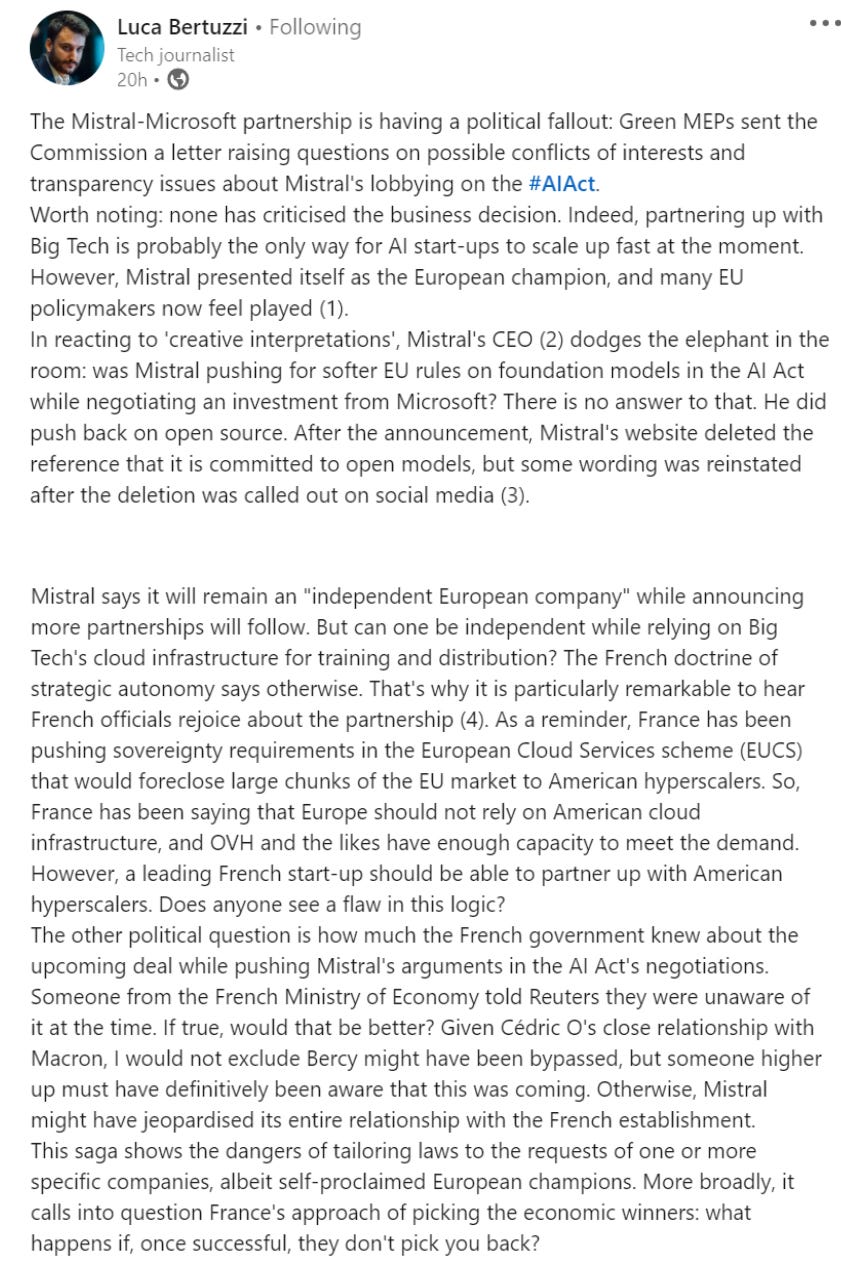
The AI lab Mistral made the headlines this week after announcing a partnership with tech behemoth Microsoft. Although there is nothing surprising in such a move from a business perspective, and there is probably no other path to growth for the French start-up, it still arose righteous indignation amid Mistral’s extensive lobbying against the EU AI Act.
France was one of the most vocal opponents of introducing stricter AI regulation on a European level, citing the protection of its local hero Mistral as its central argument. Ultimately, Mistral did manage to gain exemptions from many of the AI Act’s obligations concerning foundation model builders, aimed at preserving its competitiveness vis-à-vis American counterparts.
Now, Green MEPs are asking whether there wasn’t a conflict of interest, and more particularly: were negotiations with Microsoft ongoing at the time Mistral was pushing for softer EU rules? If, yes, were French authorities aware? Luca Bertuzzi lists all the relevant questions, but it is still not clear who will give the answers:
Thank you for reading! I hope you found this article insightful.
If you’d like to keep up with the latest developments at the burgeoning intersection of blockchain and AI, I invite you to subscribe.
And if you find value in my writing, consider supporting the newsletter. I’d greatly appreciate it.
The Web3 + AI Book Club is live on Fable. Follow the link below and come join our literary community.
I'm looking forward to connecting with fellow Crypto x AI enthusiasts, so don't hesitate to share your thoughts here or reach out on LinkedIn, Instagram, or Firefly.social.
Disclaimer: The content of this newsletter is provided for informational and educational purposes only. Nothing contained herein should be construed as financial advice or as a recommendation to buy, sell, or hold any of the companies or assets mentioned.
Please don’t take my views at face value. Instead, do your own research (DYOR), think critically, and share your perspective so we can challenge ideas, learn from one another, and arrive at better conclusions through thoughtful discussion.