

Hello, everyone, and welcome to all newly joined subscribers!
This is the 75th edition of The Web3 + AI Daily - your definitive guide to the intersection of blockchain and AI. Today, I’m taking a deep dive into Aztec, Ethereum’s privacy-focused Layer-2 chain, and the EU AI Act, which has just partially entered into force.
Thank you for being here! Let’s dive in.
What’s Hot in Web3 + AI?
Aztec Launches Alpha V5, Cuts Team in Half
Those of you who regularly read my newsletter know that privacy is a topic I care deeply about. It’s also one of the most consequential verticals in the crypto space, whose importance is only growing as AI becomes more pervasive. That’s why today I’m taking a closer look at Aztec - the Ethereum Layer-2 chain designed for private transactions.
It’s been a couple of turbulent months at Aztec. After launching its mainnet and token $AZTEC in January, in June the network suffered two consecutive hacks within the span of a single week.
Aztec Network has been hit by another $2 million hack, its second this week. Following Sunday’s $2.2 million loss from Aztec Connect, Aztec’s Private Rollup Bridge has now been drained of a similar amount. The firm stressed, in both cases, that the affected contracts are “immutable” and were “deprecated” in 2022 and 2023.
These incidents didn't stop the team from building, though, since in in mid-July Aztec released Alpha V5 - a major protocol upgrade introducing faster and cheaper private transactions, alongside applications that combine confidential user data with public blockchain state.


Why is this important? Aztec opens the door for a wide range of industries and use cases to leverage decentralized computing without compromising the confidentiality of their data. Something as simple as receiving your salary on-chain can now be performed risk-free.
Moreover, along with Alpha V5 came Shield - a private bridge for moving assets between Ethereum and Aztec, powered by human.tech by Holonym Foundation. This is a significant breakthrough that, if successfully applied across the industry, could revolutionize compliance and KYC (Know Your Customer) practices.
Shield lets users bridge assets while proving the sender is legitimate and the funds are compliant, all without revealing their identities.

Finally, last week, Aztec announced a 18-person layoff, representing roughly 55% of the workforce.
Building a fully decentralized, privacy-first L2 from scratch takes a big organisation focused on that specific task. Securing one, and filling it with applications people actually use, takes a different set of skills dedicated to stability and commercial success. . We shipped the network. The job in front of us is different from the job behind us, and the Foundation needs to adapt to meet this moment.

Aztec claims that the foundation is well capitalized "for many years of operation at this size." Speaking from experience, I don't believe such a significant restructuring is driven solely by a shift in strategic focus - development work will continue behind the scenes regardless. Rather, it suggests that, like much of the crypto industry, the bear market is taking a heavy toll on the company.
More
The EU AI Act Enters Into Force
August 2nd, 2026 marked the day when some of the provisions of the EU AI Act took effect, along with new transparency obligations for AI providers and deployers. The following post by Oliver Patel, AIGP, CIPP/E, MSc informs on all you need to know:
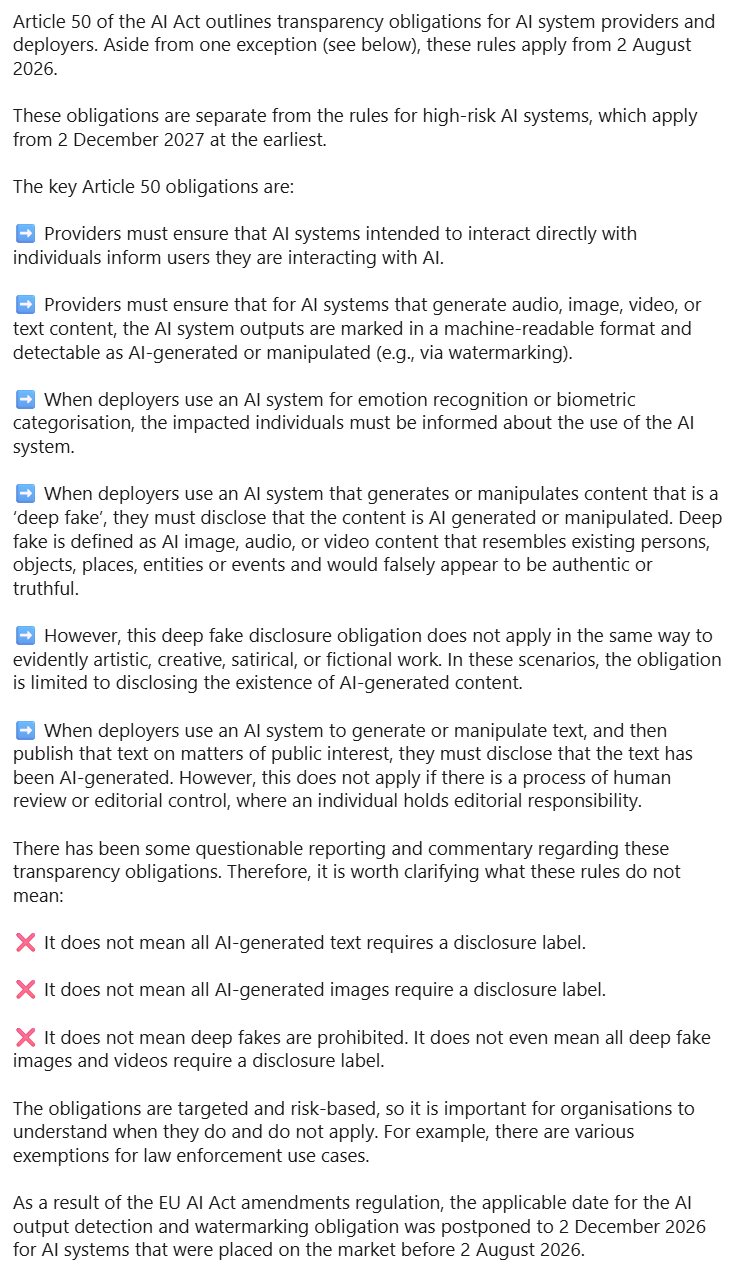
However, as Bruna Santos and Jacobo Castellanos commented for Tech Policy Press, some of the exemptions set out in the guidelines are so vague that they open friction points and risk watering down the rules:
Meanwhile, there are numerous provisions that are yet to become applicable and enforceable:
Several different bodies will be enforcing the rules, including the AI Office, the national competent authorities, and the European Data Protection Supervisor. In short, the work is ongoing and there’s still a lot to be done to ensure EU citizens’ safety.
I must say, I’ve been critical of the EU AI Act in the past, largely because I believed that overregulation would further slow an AI industry that was already lagging behind the U.S. However, while Europe still has a long way to go, I’m increasingly grateful to live in a place where the whims of tech billionaires aren’t simply accepted without scrutiny.
I’ll continue following closely the effects of the AI Act and discuss them with you here. Let me know your thoughts.
Thank you for reading! I hope you found this article insightful.
If you’d like to keep up with the latest developments at the burgeoning intersection of blockchain and AI, I invite you to subscribe.
And if you find value in my writing, consider supporting the newsletter. I’d greatly appreciate it.
The Web3 + AI Book Club is live on Fable. Follow the link below and come join our literary community.
I'm looking forward to connecting with fellow Crypto x AI enthusiasts, so don't hesitate to share your thoughts here or reach out on LinkedIn, Instagram, or Firefly.social.
Disclaimer: The content of this newsletter is provided for informational and educational purposes only. Nothing contained herein should be construed as financial advice or as a recommendation to buy, sell, or hold any of the companies or assets mentioned.
Please don’t take my views at face value. Instead, do your own research (DYOR), think critically, and share your perspective so we can challenge ideas, learn from one another, and arrive at better conclusions through thoughtful discussion.