

Hello, everyone, and welcome to all newly joined subscribers!
This is the 105th edition of The Web3 + AI Daily - your definitive guide to the intersection of blockchain and AI! On the agenda today are Brave and NEAR AI offering private and encrypted AI assistance, and OpenRoboto and peaq granting each machine a decentralized identity. I'm also sharing the latest Khala Research study on robotics' data problem.
Thank you for being here! Let’s dive in.
What’s Hot in Web3 + AI?
Brave Teams Up with NEAR AI to Encrypt AI Chat
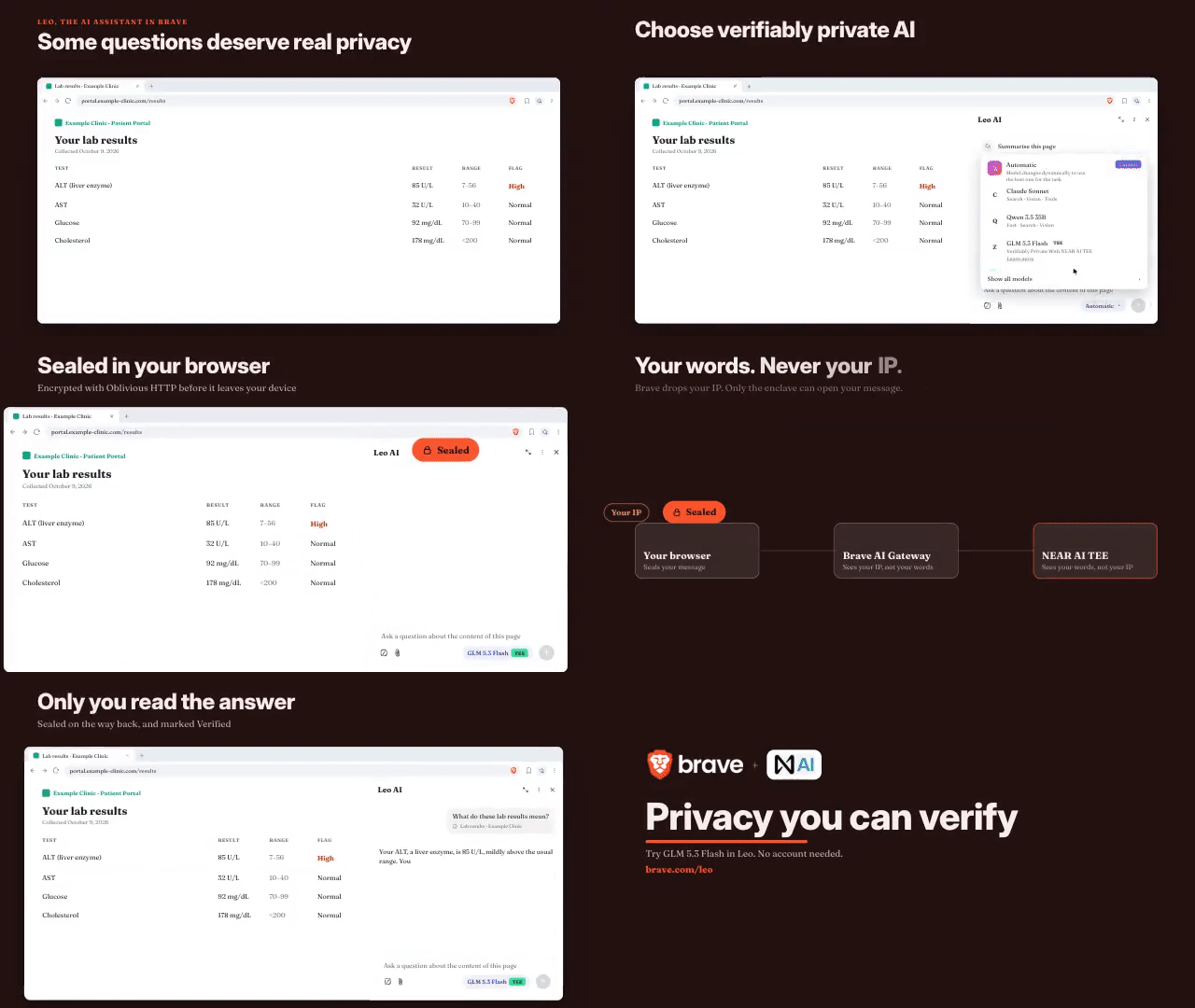
Brave allied with NEAR AI to make its in-browser AI assistant Leo end-to-end encrypted, offering industry-leading privacy.
The AI model behind Leo - the open-weight GLM 5.3 Flash, runs inside a sealed, NVIDIA-backed hardware enclave, operated by NEAR AI, which isolates users’ prompts and data from both Brave and NEAR.
Conversations with the open-weight GLM model in Leo are protected by end-to-end encryption and hardware-backed confidential computing. Your Brave browser encrypts each prompt on your device, before leaving your device, such that only an attested Trusted Execution Environment (TEE) can decrypt your prompts and run confidential LLM inference on it.

Users are reportedly sharing more and more sensitive information with AI:
In a 2026 KFF poll, a third of U.S. adults said they’d turned to AI chatbots for health information, and 41% of them had uploaded personal medical information such as test results or doctors’ notes.
And at work, a 2025 LayerX report found that 77% of employees who use AI tools paste data into them, with more than a fifth of those pastes containing personal or payment-card information.
Meanwhile, frontier AI labs aren’t just indifferent to privacy - they’re actively incentivized against it. More user data means better models and competitive advantage, all paid for with users’ personal information.
A 2025 Stanford study found that six leading U.S. AI developers appear to train their models on users’ chats by default, and some keep those chats indefinitely.
That's why I consider this move by Brave so important. With browsers often preferred as the go-to interface to AI assistance, verifiable privacy becomes a genuine competitive advantage - particularly against rivals like Google, whose business model depends on maximizing data extraction rather than protecting the people who generate it.
OpenRoboto and peaq to Assign Decentralized Identity to Machines
OpenRoboto, a Bittensor / Opentensor Foundation subnet building robot intelligence, is partnering with peaq to equip every data collector on its platform with its own decentralized identity (DID) on Solana.
OpenRoboto recently unveiled Shift, a decentralized network for collecting egocentric robotics data - first-person video of people doing real work, which can ultimately be used to train robots. Shift currently coordinates around 30 people in factories, kitchens, and warehouses, each recording first-person footage through OR-S1, a dual-camera wearable.
Now those machines carry a verifiable identity: a device-level record establishing what the hardware is and who operates it, along with a traceable origin for the data it generates. That gives buyers a way to confirm a recording came from a real capture device rather than a fabricated one - a meaningful first link in the chain of trust for training data.


Web3 + AI Readings & Conversations
Khala Research: The Robotics Data Problem
A brand-new Khala Research study has just been published, which, incidentally, underscores why the OpenRoboto - peaq integration matters. It argues that robotics development is currently constrained primarily by data availability, rather than algorithmic advances or compute capacity. The sector lacks datasets large and diverse enough to cover routine physical tasks across varied environments, which partly explains why robotics has yet to experience a turning point comparable to what transformers brought to language models.
The authors highlight four emerging networks - Axis Robotics, BitRobot Foundation, Eastworlds, and THOR, exploring decentralized data-collection models, leveraging crypto incentives to access contributors and environments that lie beyond the reach of conventional vendors. Read more here.
Thank you for reading! I hope you found this article insightful.
If you’d like to keep up with the latest developments at the burgeoning intersection of blockchain and AI, I invite you to subscribe.
And if you find value in my writing, consider supporting the newsletter. I’d greatly appreciate it.
The Web3 + AI Book Club is live on Fable. Our October title is 'Against Tech Oligarchy' by JS Tan and Clarissa Redwine. Follow the link below and come join our literary community.
I'm looking forward to connecting with fellow Crypto x AI enthusiasts, so don't hesitate to share your thoughts here or reach out on LinkedIn, Instagram, or Firefly.social.
Disclaimer: The content of this newsletter is provided for informational and educational purposes only. Nothing contained herein should be construed as financial advice or as a recommendation to buy, sell, or hold any of the companies or assets mentioned.
Please don’t take my views at face value. Instead, do your own research (DYOR), think critically, and share your perspective so we can challenge ideas, learn from one another, and arrive at better conclusions through thoughtful discussion.