

Hello, everyone, and welcome to all newly joined subscribers!
This is the 89th edition of The Web3 + AI Daily - your definitive guide to the intersection of blockchain and AI. The tech world is buzzing over allegations that OpenAI appropriated the research from two mathematicians to develop a solution to the Navier–Stokes problem. Beyond the controversy, the case raises the bigger question of what would the future of AI-powered science look like? It also underscores the urgency of building AI that is private, verifiable, and trustworthy - precisely the raison d’être of decentralized AI.
Thank you for being here! Let’s dive in.
What’s Hot in Web3 + AI?
Did OpenAI Steal the Navier-Stokes Solution?
A major scandal has been brewing in the tech world over the last couple of days. On Tuesday, OpenAI boasted that its AI agents solved the Navier-Stokes existence and smoothness problem, one of the most important open problems in theoretical mathematics. Yet, just hours earlier, NYU mathematics professor Tristan Buckmaster, in collaboration with Anthropic mathematician Levent Alpöge, published a preliminary finding on the same problem and accused OpenAI of having used their work without crediting them.
How could OpenAI have stolen the proof, you would ask. Buckmaster and Alpöge used a mix of AI models in their work, but relied primarily on OpenAI’s Codex. OpenAI tried to refute any suggestion of regurgitation, but they acknowledged that this is still a possibility:
“We (the researchers and the agents) did not see any of their work through any means until they released it publicly — in particular, no specific user data was accessed in order to solve this problem,” the post reads. “While unlikely, we cannot rule out that de-identified data derived from their usage of our products helped improve our models.
Moreover, while OpenAI claimed to have reached the solution in 88 hours, Buckmaster countered that “It is not the direction one arrives at in a few days by giving a model the problem statement.”
Finally, when Buckmaster expressed an intention to go public, OpenAI’s Bubeck went as far as issuing direct threats:
Million-Dollar Questions
Navier-Stokes is one of Clay Mathematics Institute's seven Millennium Prize Problems, each carrying a prize of $1M for the correct solution. Yet, this whole story raises other important questions we should seriously consider:
What will the future of science be? For years now, the AI industry has been trying to sell the idea that AI will be tremendously useful for scientific research and discovery, but what if every new invention is devoured by the reigning AI lab?
Why would anyone pursue a career in the sciences, if every progress they make is tied to AI, and by extension - at the mercy of major labs?
Will the “bright,” abundant future that AI companies promise come at the expense of intellectual diversity and plurality of ideas? And will it come at all if we allow AI companies to undermine and outright threaten scientists?
There Must Be Another Way
The biggest issue here is that there’s no way for Buckmaster and Alpöge to check and prove whether their work and prompts were fed into the OpenAI model that solved Navier-Stokes. And there should be.
As NEAR AI commented:
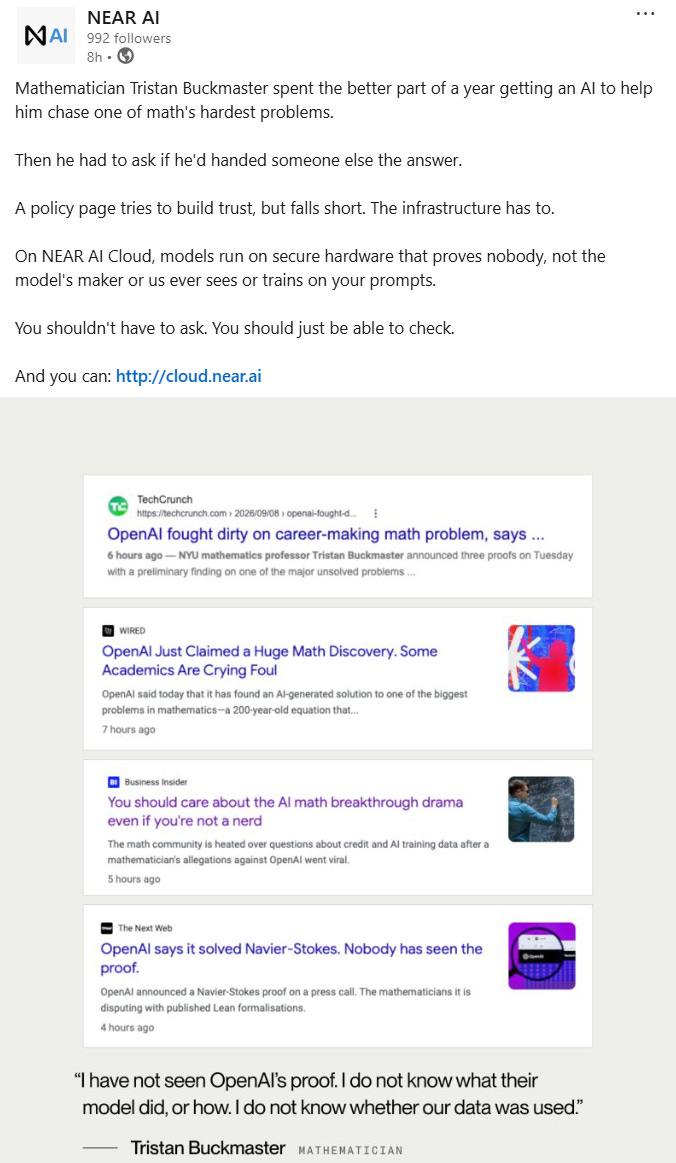
This is what we in the Decentralized AI space have been preaching for years - that AI should be:
Private, i.e., running in closed enclaves and using encrypted computation, so no personal or corporate data gets leaked.
Verifiable, so users can check the model, the infrastructure, the training data, and prove that the result they get from their chatbot or agent is valid. It’s simply irresponsible to transfer entire industries to AI when we’re unable to verify what model runs in the background and what data it was trained on.
We cannot trust Big Tech to build a fair and equitable future around AI, because they have no incentive to do so. Fortunately, there are alternatives, both in and outside Web3.
The Web3 + AI Book Club
In September We’re Reading ‘The Nerd Reich’
The latest title in our Book Club strongly resonates with everything we discussed so far today. In September, we’re exploring ‘The Nerd Reich: Silicon Valley Fascism and the War on Democracy’ by journalist and podcaster Gil Duran - an investigation into the antidemocratic ideologies espoused by tech billionaires, both the crypto and the AI ones.
Where do I see the connection between the book and the OpenAI controversy discussed above? In the fact that an excessive concentration of power inevitably creates opportunities for abuse.
Whatever the outcome of the dispute of OpenAI vs. Buckmaster and Alpöge, I doubt it will have any serious repercussions for the company. If anything, OpenAI is likely to emerge from it boasting that its models are powerful enough to autonomously solve humanity’s most difficult problems, while the people whose work made those breakthroughs possible remain largely unknown to the public.
And this is precisely what Duran is writing about: when power becomes concentrated, accountability tends to disappear along with it.
I invite you to join our literary community on Fable and read with us here.
Thank you for reading! I hope you found this article insightful.
If you’d like to keep up with the latest developments at the burgeoning intersection of blockchain and AI, I invite you to subscribe.
And if you find value in my writing, consider supporting the newsletter. I’d greatly appreciate it.
The Web3 + AI Book Club is live on Fable. Our September title is 'The Nerd Reich' by Gil Duran. Follow the link below and come join our literary community.
I'm looking forward to connecting with fellow Crypto x AI enthusiasts, so don't hesitate to share your thoughts here or reach out on LinkedIn, Instagram, or Firefly.social.
Disclaimer: The content of this newsletter is provided for informational and educational purposes only. Nothing contained herein should be construed as financial advice or as a recommendation to buy, sell, or hold any of the companies or assets mentioned.
Please don’t take my views at face value. Instead, do your own research (DYOR), think critically, and share your perspective so we can challenge ideas, learn from one another, and arrive at better conclusions through thoughtful discussion.