


Hello, everyone, and welcome to all newly joined subscribers!
This is the 104th edition of The Web3 + AI Daily - your definitive guide to the intersection of blockchain and AI! On the agenda today is an AI & blockchain concierge to accompany you on your next trip to Japan, and the true state of agentic commerce.
Thank you for being here! Let’s dive in.
What’s Hot in Web3 + AI?
Kite Equips Japan Tourists with AI Travel Concierge Flattora
Kite, a payment layer for the agentic economy, has unveiled Flattora - “an AI travel concierge that allows travelers to discover, book, and pay for authentic local experiences across Japan.” Flattora is powered by Kite’s AI agent ZUKKU, and developed in collaboration with Proof of Japan, a joint venture between SMBC Nikko Securities Inc. and the AI company Hatapro.
Flattora brings the Japanese concept of omotenashi, or wholehearted hospitality, into the digital travel experience. ZUKKU guides users through a three-step experience: AI suggests curated experiences, the user approves and sets a budget, and ZUKKU autonomously handles all subsequent purchases within those rules.
The payments infrastructure underpinning Flattora is built by Kite. Kite Agent Passport gives ZUKKU a scoped, programmable wallet session that operates within rules set entirely by the user. Travelers define an auto-approve limit, which sets the maximum amount that can be processed in a single transaction without asking, as well as a total trip budget. ZUKKU then operates autonomously within those guardrails, with every transaction recorded on-chain for full transparency.
ZUKKU can directly negotiates with a host’s agent and perform payments via Google ‘s agent-to-agent (A2A) and Coinbase‘s x402 protocols.
Using AI and blockchain, Flattora addresses a key obstacle the majority of international tourists are facing:
Many of Japan’s most extraordinary travel experiences, including family-run ryokan, local craft workshops, regional food culture, and seasonal festivals, remain largely out of reach for international visitors. The barrier is not interest; it is distribution. Local providers are fragmented across Japanese-language platforms, reservation flows are complex, and foreign payment methods often fail at the last step. The result: tourism concentrates in a handful of major cities while the rest of Japan goes undiscovered. Flattora is built to close that gap.

Agents Executed 138M x402 Transactions in a Year. Or Did They?
A new Chainalysis report examined x402, the most popular and widely used agentic payments rail, and its activity on Coinbase‘s Base chain in particular. It estimated that the number of crypto payments performed through it grew from 1,500 in mid-2025 to over 138 million by Q3 2026. The report suggests that all these transactions were agent-initiated, though no supporting evidence is presented.
According to Chainalysis, the majority of the payments recorded by September 2026 were micro- and nano-transactions:
Over 87% of payments fall between a hundredth of a cent and a dime, with the most common size between one and ten cents.
There's a maturation being observed around x402, as the kinds of products and services x402 transactions pay for are also shifting. Early activity was mostly memecoins; today the protocol carries longer-lived agentic commerce, especially around information services:
These details may suggest that all x402 transactions are indeed initiated by AI, but is that really the truth?
What Chainalysis Doesn’t Say About x402’s Agentic Activity?
The Chainalysis report does not specify what share of the commerce running through x402 is actually agentic, nor does it define the criteria used to classify an address as agentic.
On one occasion, the report employs the phrase ‘AI wallets.’ To clarify their methodology, I queried Chainalysis’s chatbot on how they classify an address as an AI wallet. Here’s the answer:
“AI wallet” isn’t a universal on-chain standard, so when we use that label it’s generally an attribution category: wallets we have high confidence are controlled by an AI agent/service (for example, an agent platform or automated agent-controlled account), based on a mix of on-chain behavior patterns plus entity attribution intelligence.
Meanwhile, a TRM Labs study published in September concluded that only between 0.6% and 7.5% out of $25.62 million - the size of the authentic x402 commerce in the period between May 2025 and September 2026 - appear to be agentic.
The two reports point to strikingly different conclusions, so let’s unpack them.
How Much of x402 Is Really Agentic?
TRM Labs' analysis offers a far more granular and in-depth account of x402 activity, which is why I lean toward treating its findings as the more credible of the two. Here are its key findings and methodological principles:
First, both humans and agents can use x402.
x402 was designed for agentic commerce, but nothing in the protocol requires an agent. Anyone who writes a script can drive the same
402sequence, and it leaves an identical onchain record.
Second, x402 is not limited to Base chain, but operates on all EVM chains, Solana, NEAR Protocol, and others.
Across Base, Solana, and Polygon Labs, TRM identified roughly $52.7 million across 198.9 million settlement transactions mediated by known x402 facilitators since May 2025.
Third, not every x402 transaction constitutes commerce. According to TRM Labs, about half of the settled volume since May 2025 represent self-payment, bulk flows, and thin-buyer sellers.
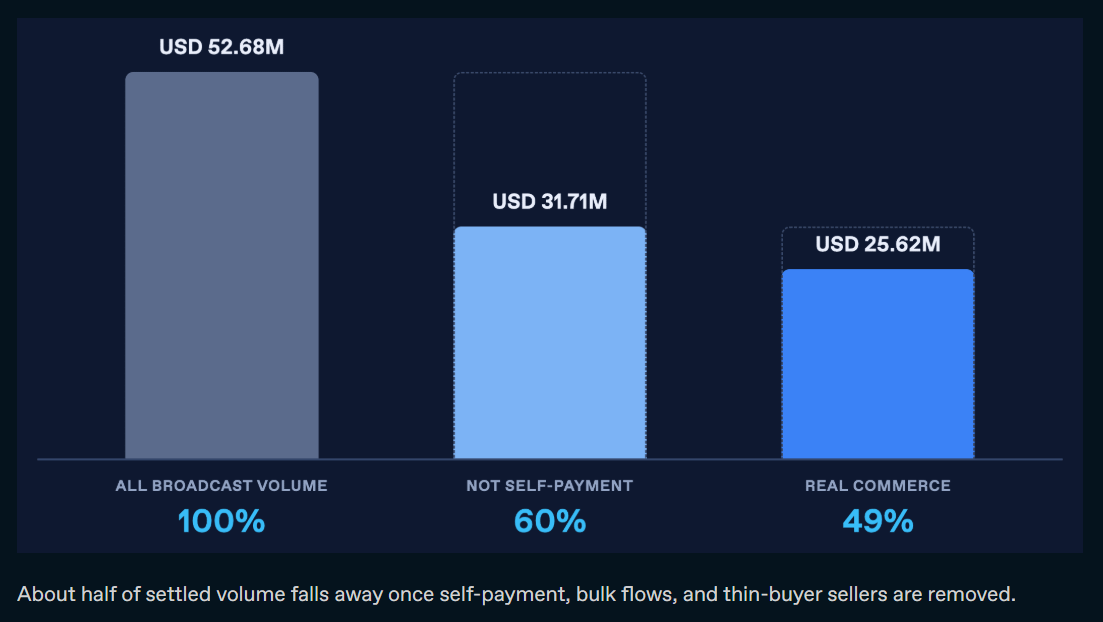
Fourth, what counts as an agent, and how agents behave, remains an open question. TRM Labs used two methodologies to define which participants qualify as AI agents: one more permissive, one more restrictive.
A permissive test that counts anything that plausibly could be an agent, and a strict test that requires a higher evidence standard.
The permissive model counts any payer that could plausibly be an agent. The payment was broadcast by a facilitator, the amounts were sub-dollar on average, and they varied rather than repeating a fixed price. The strict test keeps only those that also sustained the pattern across months and either registered in a public agent registry (ERC-8004) or paid more than one seller.
Applied to the $25.62 million of screened x402 commerce, the two tests put the share that appears to be agentic at between 0.6% and 7.5%. Price variation significantly limits the agentic population. The assumption is that a true agent explores across multiple services and products, while an address repeating the same price behaves more like a script hitting one service over and over. This is a deliberate modeling choice, and it may understate the space: many agents today could be single-purpose, paying one service repeatedly, which this test would read as a script.
These assumptions and methodology choices are what give us a fuller, more nuanced picture of today’s agentic economy - and they were missing from the Chainalysis report, at least from the version I had access to and shared above.
That’s why I lean toward TRM Labs’ account, and why I’m not inclined to get too excited about the ‘spectacular’ growth of agentic payments. So when you see a headline like ‘AI Agents Made 138 Million Crypto Payments in a Year,’ take it with a grain of salt. Counting transactions without counting volume only tells half the story.
Thank you for reading! I hope you found this article insightful.
If you’d like to keep up with the latest developments at the burgeoning intersection of blockchain and AI, I invite you to subscribe.
And if you find value in my writing, consider supporting the newsletter. I’d greatly appreciate it.
The Web3 + AI Book Club is live on Fable. Our October title is 'Against Tech Oligarchy' by JS Tan and Clarissa Redwine. Follow the link below and come join our literary community.
I'm looking forward to connecting with fellow Crypto x AI enthusiasts, so don't hesitate to share your thoughts here or reach out on LinkedIn, Instagram, or Firefly.social.
Disclaimer: The content of this newsletter is provided for informational and educational purposes only. Nothing contained herein should be construed as financial advice or as a recommendation to buy, sell, or hold any of the companies or assets mentioned.
Please don’t take my views at face value. Instead, do your own research (DYOR), think critically, and share your perspective so we can challenge ideas, learn from one another, and arrive at better conclusions through thoughtful discussion.