


Hello, everyone, and welcome to all newly-joined subscribers!
This is The Web3 + AI Daily, your definitive guide to the world of Decentralized AI (DeAI/dAI)! Today, we’re discussing Tether.io, NEAR Protocol, EigenCloud, and LLMs’ “brain rot”.
Thank you for being here! Let’s dive in.
What’s Hot in Web3 + AI?
Tether Unveils dAI Dataset, App to Power Private Intelligence
Stablecoin giant Tether.io has launched QVAC Genesis I, a 41-billion-token synthetic dataset designed for training open, STEM-oriented AI models, along with QVAC Workbench, a privacy-focused AI app that runs fully on users’ devices.
Tether’s goal is to decentralize AI, shifting control away from major tech firms such as OpenAI and Google, by enabling private, on-device intelligence with no cloud dependency or central gatekeepers.
The dataset is fully synthetic (not scraped from the public web) and has been validated on science and engineering benchmarks, whereas the app also supports peer-to-peer delegated inference so heavy computations can be offloaded securely between devices.
Finally, Tether hints at integration of blockchain rails (e.g., its stablecoin USDT and Bitcoin) so that AI agents could eventually transact autonomously, suggesting this effort is part of their broader ambition to influence both finance and intelligence infrastructure.
NEAR Fails to Cut Inflation
A recent governance proposal to cut NEAR Protocol’s annual token emission rate from 5% down to 2.5% didn’t pass. The vote achieved a simple majority, but failed to hit the required approval threshold of 66.67% under NEAR’s governance rules.
The proposal aimed to reduce inflation given low fee-burns and limited usage of the network. The practical background: NEAR is issuing about $140M annually in tokens to secure the chain, while its total value locked (TVL) is around $157M and total fees year-to-date only about $3.2M, suggesting high inflation relative to usage.
For context, Solana’s estimated annual issuance is roughly $5.5B, but it supports a far larger, more active DeFi ecosystem with around $11B in TVL. From a purely economic lens, NEAR is definitely “overpaying” for security.
Despite the outcome, there are signs that core contributors may proceed with implementation via a software upgrade (nearcore v2.9.0) to carry out the reduction regardless of formal vote result, sparking concerns about governance integrity and decentralization.
Web3 + AI Readings & Conversations
LLMs Can Get “Brain Rot” and Spikes in Psychopathy
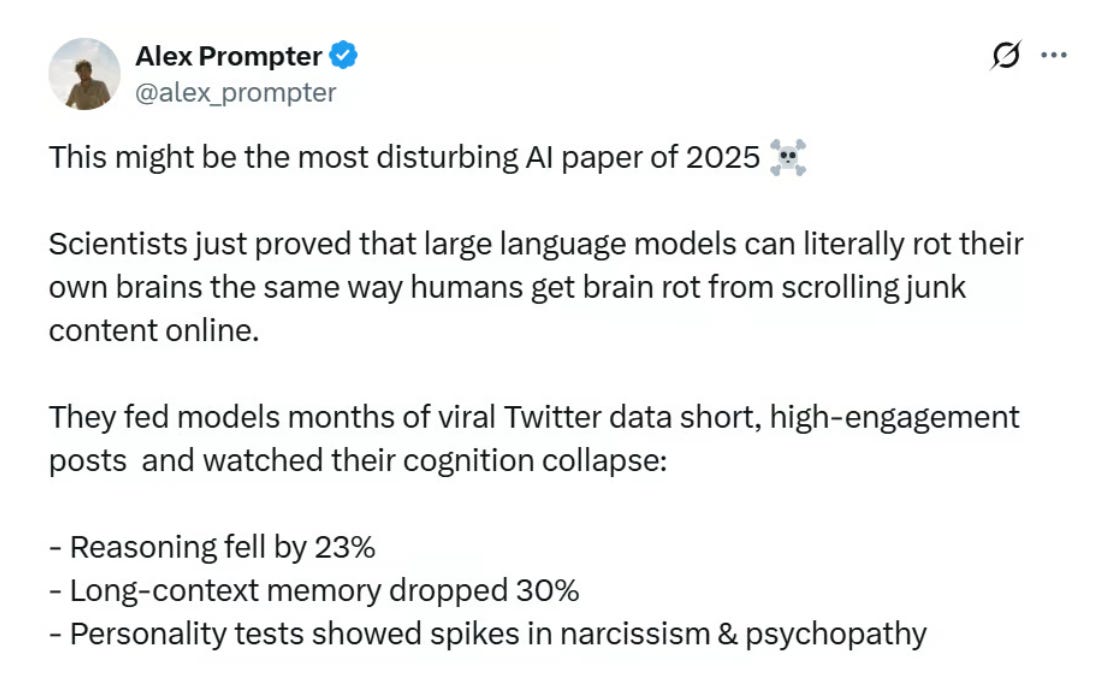
Most importantly, the damage and cognitive decline observed with LLMs seemed to be permanent and didn't significantly improve even after retraining with high-quality data. Read the full paper to learn more.
Alea Research Explores EigenAI & EigenCompute
Alea Research has published a deep dive into EigenCloud, explaining how it built on EigenLayer’s restaking model to introduce two new services: EigenAI (for verifiable large-language-model inference) and EigenCompute (for verifiable off-chain compute work). By doing so, it addressed one core problem: many AI-services operate as black-boxes (prompts, models, responses may be altered, unverifiable), making them unsuitable for high-stakes scenarios.
EigenAI aims to ensure “untampered prompts, untampered model, untampered output”. By offering deterministic, verifiable LLM inference, it serves industries and use cases that require that given the same prompts and parameters, identical outputs are produced.
On the other hand, EigenCompute allows developers to upload agent/app logic (e.g., a Docker image) and execute it in Trusted Execution Environments (TEEs) with cryptoeconomic backing (slashing, staking) for integrity.
Practical use cases, where verifiability of inference and execution is essential, include autonomous trading agents, agent-to-agent payments, prediction markets, digital companions, etc.
More
North Korean Hackers Leverage AI for Crypto Exploits
CoinDesk offers a sneak peek into a Web3 + AI vertical we may not often consider: AI facilitating crypto crimes. The media outlet reports that state-backed hackers from North Korea are increasingly using artificial intelligence tools to target cryptocurrency systems.
Hackers are using AI tools for reconnaissance, scanning smart-contract code, identifying vulnerabilities, executing exploits across multiple blockchains, conducting phishing attacks and laundering stolen crypto funds. Because open-source smart-contract code is widely available, attackers using AI can spot weaknesses faster and replicate successful exploits across protocols, scaling attacks more efficiently than before.
While much of the crypto-security community has been focused on the threat of quantum computing, the article argues that AI is the more immediate and active threat to blockchain ecosystems.
Thank you for reading! I hope you found this article insightful.
If you’d like to keep up with the latest developments at the burgeoning intersection of blockchain and AI, I invite you to subscribe.
And if you find value in my writing, consider supporting the newsletter. I’d greatly appreciate it.
The Web3 + AI Book Club is live on Fable. Follow the link below and come join our literary community.
I'm looking forward to connecting with fellow Crypto x AI enthusiasts, so don't hesitate to share your thoughts here or reach out on LinkedIn, Instagram, or Firefly.social.
Disclaimer: The content of this newsletter is provided for informational and educational purposes only. Nothing contained herein should be construed as financial advice or as a recommendation to buy, sell, or hold any of the companies or assets mentioned.
Please don’t take my views at face value. Instead, do your own research (DYOR), think critically, and share your perspective so we can challenge ideas, learn from one another, and arrive at better conclusions through thoughtful discussion.