

Hello, everyone, and welcome to all newly joined subscribers!
This is the 101st edition of The Web3 + AI Daily - your definitive guide to the intersection of blockchain and AI! Today, we’re examining the proposed Bittensor Gamma tokens - transferable usage credits designed to facilitate the exchange of AI services and infrastructure resources. Will they reshape Bittensor’s economy and its broader machine intelligence ecosystem?
Thank you for being here! Let’s dive in.
Bittensor’s New Chapter
At the end of September, the Bittensor / Opentensor Foundation community held its flagship event, the Exploit Summit, and gathered subnet operators, miners, stakeholders, and fans in Montreal. In his opening talk, Jacob Robert Steeves (Const) outlined the current state of the network and the strategy for where it should go next.
Sidebar for anyone unfamiliar with Bittensor: Bittensor is one of the most important projects in decentralized AI. At its core, it’s a network of separate, highly specialized ‘subnets’ that use monetary incentives to coordinate people and machines around the world to perform AI-related tasks - from data collection and storage to inference, fine-tuning, pre-training, and post-training.
The Road Ahead
Bittensor’s strategy over the past few years has centered on incentivizing the creation of new subnets and the execution of new tasks, rather than prioritizing profitability. As a result, only 23 out of 128 subnets currently have paying customers and generate revenue. Check out SubConnect’s Bittensor Revenue Index below:


Therefore, as Const put it, the network’s priority now should be to become profitable and make its subnets self-sufficient. He presented a few key steps to achieve that:
Incentivizing subnets that attract real buyers of their product. Going forward, the network will measure each subnet’s ability to attract external customers and use that performance to determine which subnets deserve a larger share of emissions. Const suggested that subnets should target individuals that buy Alpha tokens (see below) and purchase usage credits from other chains.
Subnets becoming each other’s clients. Many subnets already utilize other digital commodities within the network, but from now on, a standardized framework will facilitate it.
Introducing Gamma tokens: a canonical standard for usage credits. Gamma tokens are designed to expand demand for infrastructure services produced by the Bittensor ecosystem. As Const explained, they will make it easier for external clients to access Bittensor’s machine intelligence products:
We’re building this full bridging technology so all of the usage credits on Bittensor across our variety of infrastructure providers is something the people can use outside of the system.
Meanwhile, Gamma tokens will also boost internal trade. Subnets will be able to direct part of their miner emissions to purchase gamma tokens to use infrastructure by fellow subnets.
How the Gamma Tokens Will Fit in Bittensor’s Tokenomics?
In fact, Gamma tokens are not live yet. They are reportedly set to launch in early 2027, initially across a small group of subnets:
Steeves named seven subnets as the initial Gamma issuers: Chutes AI, Engy, GM, Lium, Targon, Hippius, and Affine. These are the infrastructure layer, the subnets that actually sell compute, inference, and storage to everyone else. Every other subnet on the network becomes, in effect, a customer. According to CryptoBriefing’s account of the roadmap, the standard is slated to go live in early 2027, which means the September announcement was a design reveal, not a launch.
Yet their introduction could have a significant impact on Bittensor’s tokenomics, making it worth examining the implications now. With Gamma, Bittensor’s token economy will evolve into a three-layer system:
TAO is Bittensor’s mainnet utility token created to incentivize the production of machine intelligence. Its supply design mirrors the one of bitcoin:
With the mining of each new block, new TAO coins are issued as reward to miners and validators.
The number of new TAO created each year is automatically halved over time until issuance halts completely with a total of 21 million TAO in existence. The first halving took place in 2025.
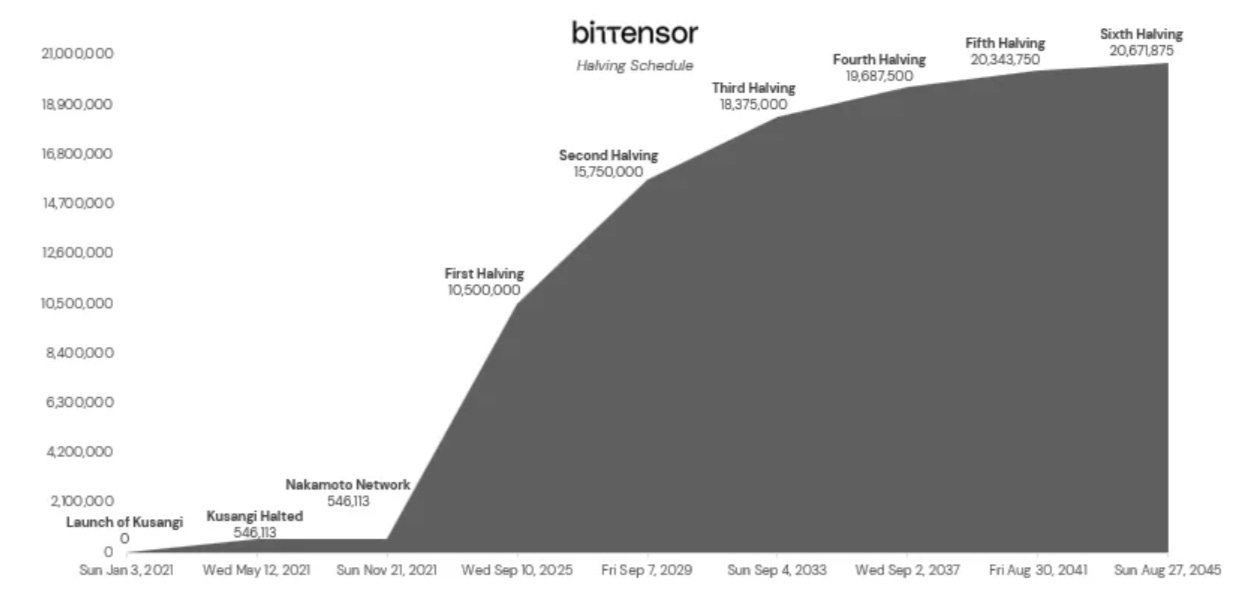
TAO is the common asset underneath the whole system, connecting all Bittensor subnets together.
2. Each subnet has its own Alpha token, which represents ownership or participation within the subnet. Alpha tokens’ issuance rate follows the model outlined below:
Each subnet can produce up to 2 Alpha tokens per block, distributed as follows:
TAO holders can stake their coins with a specific subnet to receive a proportional amount of the subnet’s Alpha tokens.
3. Gamma tokens will be transferable usage credits. Subnets will burn a portion of their own Alpha tokens to mint Gamma.
As KuCoin Exchange put it, $5 of burned Alpha becomes 5 Gamma that doesn’t fluctuate once minted. Spend it on inference, storage, or compute from another subnet, and that subnet redeems it. No TAO changes hands in the transaction itself.
Key Benefits of Gamma Tokens
It is still early to predict how Gamma tokens will impact Bittensor's economics, but most experts, including Mike Grantis, whom I cite below, see Gamma tokens as a net positive. Some of the potential benefits are:
Simplified trade of machine intelligence services: To access infrastructure resources, subnets currently have to sell either TAO or Alpha tokens, and manage chain bridging, different gas fees, key, and price volatility. Gamma tokens will abstract those frictions away.
Gamma creates a universal standard, denominated in USD, where the commodity price is not impacted by the volatility of the payment currency.
Gamma collapses this into one atomic onchain transaction that can come from any chain. [...] Once minted, the amount never changes, so a credit bought today buys the same dollar amount of work tomorrow.

The burn mechanism applied to Alpha tokens may potentially push their price up: Since subnets will have to burn Alpha tokens to mint Gamma, this will result in a decreased supply of Alpha, which may increase their value.
Subnets will transform from separate silos into an interconnected market for AI services:
Gamma token will facilitate agentic commerce:
Agents don’t sign up for accounts or fill out email forms, and they shouldn’t have to read alpha price charts before paying for inference. Gamma gives them a stable, programmatic unit of account. An agent holding 100 Gamma knows it has $100 of service and can spend it in one transaction, without API keys.
Thank you for reading! I hope you found this article insightful.
If you’d like to keep up with the latest developments at the burgeoning intersection of blockchain and AI, I invite you to subscribe.
And if you find value in my writing, consider supporting the newsletter. I’d greatly appreciate it.
The Web3 + AI Book Club is live on Fable. Our October title is 'Against Tech Oligarchy' by JS Tan and Clarissa Redwine. Follow the link below and come join our literary community.
I'm looking forward to connecting with fellow Crypto x AI enthusiasts, so don't hesitate to share your thoughts here or reach out on LinkedIn, Instagram, or Firefly.social.
Disclaimer: The content of this newsletter is provided for informational and educational purposes only. Nothing contained herein should be construed as financial advice or as a recommendation to buy, sell, or hold any of the companies or assets mentioned.
Please don’t take my views at face value. Instead, do your own research (DYOR), think critically, and share your perspective so we can challenge ideas, learn from one another, and arrive at better conclusions through thoughtful discussion.